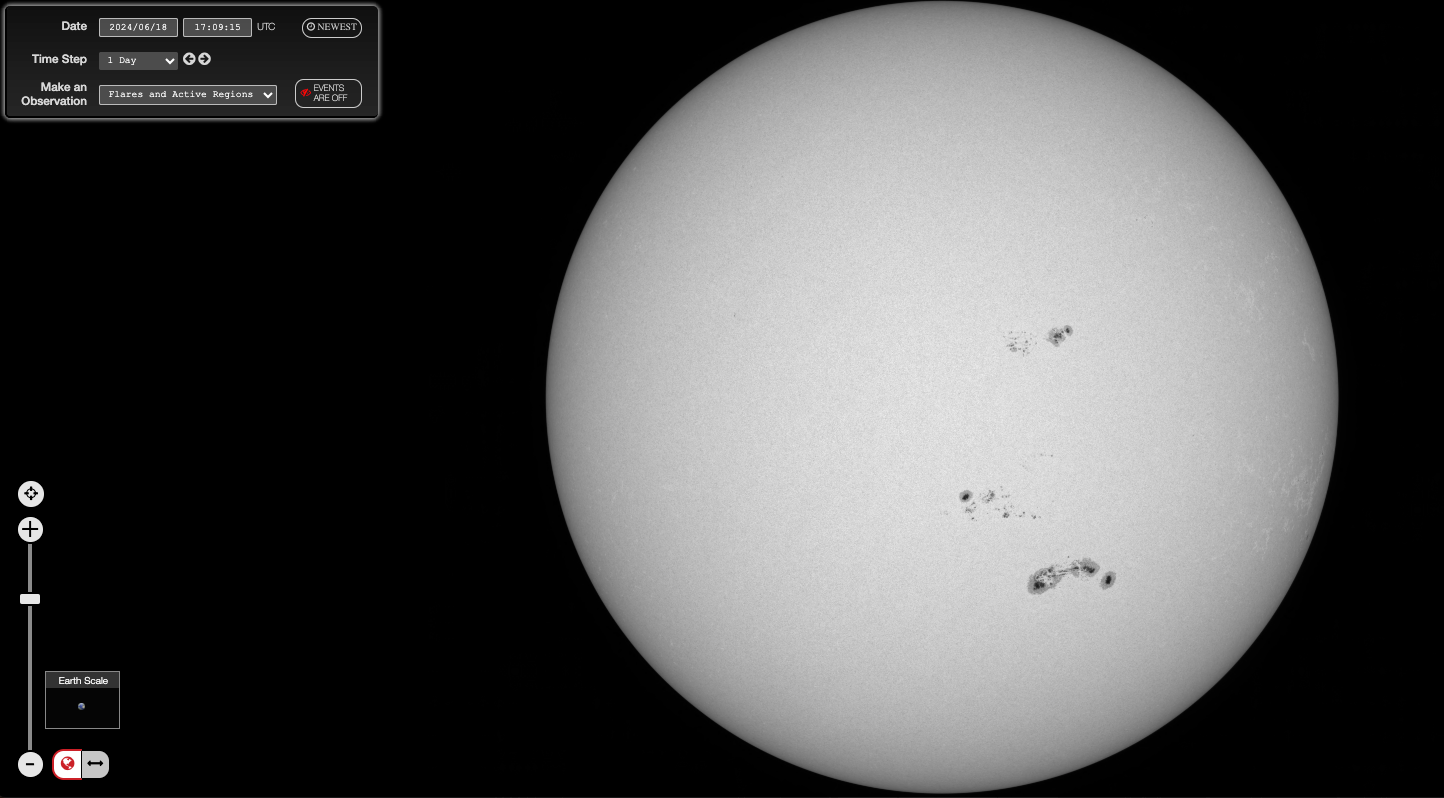
<?xml version="1.0" encoding="utf-8"?><feed xmlns="http://www.w3.org/2005/Atom" ><generator uri="https://jekyllrb.com/" version="3.10.0">Jekyll</generator><link href="https://blog.necdet.helioviewer.org/feed.xml" rel="self" type="application/atom+xml" /><link href="https://blog.necdet.helioviewer.org/" rel="alternate" type="text/html" /><updated>2026-11-03T22:38:34+00:00</updated><id>https://blog.necdet.helioviewer.org/feed.xml</id><title type="html">Helioviewer Project</title><subtitle>Visualization of solar and heliospheric data</subtitle><entry><title type="html">New Event Source - WSA Now Available</title><link href="https://blog.necdet.helioviewer.org/2026/11/03/wsa-events-available" rel="alternate" type="text/html" title="New Event Source - WSA Now Available" /><published>2026-11-03T16:00:00+00:00</published><updated>2026-11-03T16:00:00+00:00</updated><id>https://blog.necdet.helioviewer.org/2026/11/03/wsa-events-available</id><content type="html" xml:base="https://blog.necdet.helioviewer.org/2026/11/03/wsa-events-available"><![CDATA[<!-- DRAFT: replace all placeholder text, images and videos before publishing. -->

<p>A new event source, WSA, is now available in Helioviewer.org through the
<a href="/2026/11/03/events-api">Events API</a>. Lorem ipsum dolor sit amet, consectetur
adipiscing elit. Sed do eiusmod tempor incididunt ut labore et dolore magna aliqua.</p>

<p><img src="/images/uploads/2026/wsa-overview.svg" alt="Placeholder: WSA events in Helioviewer.org" /></p>

<h2 id="what-is-wsa">What is WSA?</h2>

<p>Placeholder paragraph describing WSA. Ut enim ad minim veniam, quis nostrud
exercitation ullamco laboris nisi ut aliquip ex ea commodo consequat.</p>

<h2 id="new-features">New Features</h2>

<h3 id="placeholder-feature-one">Placeholder feature one</h3>

<p>Placeholder description of the first feature. Duis aute irure dolor in
reprehenderit in voluptate velit esse cillum dolore eu fugiat nulla pariatur.</p>

<p><img src="/images/uploads/2026/wsa-feature-1.svg" alt="Placeholder: WSA feature 1" /></p>

<h3 id="placeholder-feature-two">Placeholder feature two</h3>

<p>Placeholder description of the second feature. Excepteur sint occaecat cupidatat
non proident, sunt in culpa qui officia deserunt mollit anim id est laborum.</p>

<p><img src="/images/uploads/2026/wsa-feature-2.svg" alt="Placeholder: WSA feature 2" /></p>

<h3 id="placeholder-feature-three">Placeholder feature three</h3>

<p>Placeholder description of the third feature.</p>

<ul>
  <li>Placeholder detail one</li>
  <li>Placeholder detail two</li>
</ul>

<h2 id="see-it-in-action">See It in Action</h2>

<!-- Replace VIDEO_ID with the real YouTube video id -->
<iframe width="100%" height="400" src="https://www.youtube.com/embed/VIDEO_ID" title="Placeholder video: WSA in Helioviewer.org" frameborder="0" allowfullscreen=""></iframe>

<h2 id="accessing-wsa-events">Accessing WSA Events</h2>

<p>Placeholder steps for turning on WSA events in Helioviewer.org:</p>

<ol>
  <li>Placeholder step one</li>
  <li>Placeholder step two</li>
  <li>Placeholder step three</li>
</ol>

<h2 id="feedback">Feedback</h2>

<p>We welcome feedback on the new WSA event source. You can reach the team at
<a href="mailto:HelioviewerDevelopment@nasa.onmicrosoft.com">HelioviewerDevelopment@nasa.onmicrosoft.com</a></p>]]></content><author><name>Helioviewer Team</name></author><category term="Development" /><category term="General" /><summary type="html"><![CDATA[]]></summary></entry><entry><title type="html">Introducing the Helioviewer Events API</title><link href="https://blog.necdet.helioviewer.org/2026/11/03/events-api" rel="alternate" type="text/html" title="Introducing the Helioviewer Events API" /><published>2026-11-03T15:00:00+00:00</published><updated>2026-11-03T15:00:00+00:00</updated><id>https://blog.necdet.helioviewer.org/2026/11/03/events-api</id><content type="html" xml:base="https://blog.necdet.helioviewer.org/2026/11/03/events-api"><![CDATA[<!-- DRAFT: replace all placeholder text, images and videos before publishing. -->

<p>We’re pleased to announce the release of the Helioviewer Events API. Lorem ipsum
dolor sit amet, consectetur adipiscing elit. Sed do eiusmod tempor incididunt ut
labore et dolore magna aliqua.</p>

<p><img src="/images/uploads/2026/events-api-overview.svg" alt="Placeholder: Events API overview" /></p>

<h2 id="what-is-the-events-api">What is the Events API?</h2>

<p>Placeholder paragraph describing the Events API. Ut enim ad minim veniam, quis
nostrud exercitation ullamco laboris nisi ut aliquip ex ea commodo consequat.</p>

<ul>
  <li>Placeholder feature one</li>
  <li>Placeholder feature two</li>
  <li>Placeholder feature three</li>
</ul>

<h2 id="integrated-with-helioviewerorg">Integrated with Helioviewer.org</h2>

<p>Placeholder paragraph about how Helioviewer.org now uses the Events API. Duis aute
irure dolor in reprehenderit in voluptate velit esse cillum dolore eu fugiat
nulla pariatur.</p>

<p><img src="/images/uploads/2026/events-api-helioviewer.svg" alt="Placeholder: events shown in Helioviewer.org" /></p>

<!-- Replace VIDEO_ID with the real YouTube video id -->
<iframe width="100%" height="400" src="https://www.youtube.com/embed/VIDEO_ID" title="Placeholder video: Events API in Helioviewer.org" frameborder="0" allowfullscreen=""></iframe>

<h2 id="using-the-api">Using the API</h2>

<p>Placeholder paragraph with an example request:</p>

<div class="language-plaintext highlighter-rouge"><div class="highlight"><pre class="highlight"><code>GET https://events.helioviewer.org/api/v1/PLACEHOLDER
</code></pre></div></div>

<h2 id="feedback">Feedback</h2>

<p>We welcome feedback on the new Events API. You can reach the team at
<a href="mailto:HelioviewerDevelopment@nasa.onmicrosoft.com">HelioviewerDevelopment@nasa.onmicrosoft.com</a></p>]]></content><author><name>Helioviewer Team</name></author><category term="Development" /><category term="General" /><summary type="html"><![CDATA[]]></summary></entry><entry><title type="html">Helioviewer Boosts Sunspot Study with Modernized Analysis</title><link href="https://blog.necdet.helioviewer.org/2026/10/27/helioviewer-sunspot-study" rel="alternate" type="text/html" title="Helioviewer Boosts Sunspot Study with Modernized Analysis" /><published>2026-10-27T15:00:00+00:00</published><updated>2026-10-27T15:00:00+00:00</updated><id>https://blog.necdet.helioviewer.org/2026/10/27/citation</id><content type="html" xml:base="https://blog.necdet.helioviewer.org/2026/10/27/helioviewer-sunspot-study"><![CDATA[<p>A new study investigating sunspots and solar cycles highlights how NASA’s Helioviewer data visualization tool supports scientific discovery and optimizes analysis. Compressed images of the Sun from Helioviewer served as the primary source material in the <a href="https://link.springer.com/article/10.1007/s11207-025-02598-7?utm_source=springer_etoc&amp;utm_medium=email&amp;utm_campaign=CONR_11207_AWA1_GL_DTEC_054CI_TOC-190226&amp;utm_content=etoc_springer_20260219#Sec1">paper</a> ‘Investigating Solar Cycles Using Mathematical Morphology’, published in the journal <em>Solar Physics</em>. Helioviewer files are much smaller and faster to process than the large scientific data files typically used in analysis, making inclusion in this study promising for future solar physics research applications that can be accelerated using Helioviewer images.</p>

<p>The Helioviewer team is thrilled to be recognized in this paper and proud to support NASA’s <a href="https://science.nasa.gov/open-science/">open science</a> initiative to create data analysis tools that can be easily discovered and accessed around the world.</p>

<h2 id="a-new-take-on-sunspot-analysis">A New Take on Sunspot Analysis</h2>

<p>In the study, a research team in Brazil processed and analyzed around 10,000 images of the Sun from the Helioviewer database, originally captured by the ESA-NASA Solar and Heliospheric Observatory (SOHO) and NASA’s Solar Dynamics Observatory (SDO) satellites.</p>

<p><a href="https://science.nasa.gov/sun/track-the-solar-cycle-with-sunspots/"><img src="/images/uploads/2026/helioviewer.png" alt="Image of student.helioviewer.org" /></a>
             Helioviewer allows users to see sunspots and download images in
             JPEG 2000 format.
             Credit: Helioviewer</p>

<p>Normally, solar science researchers use a raw scientific data format called <a href="https://fits.gsfc.nasa.gov/">FITS</a> (Flexible Image Transport System), which is very large and takes a long time to work with. This team instead chose to utilize Helioviewer files, which are compressed using the <a href="https://jpeg.org/jpeg2000/">JPEG 2000</a> format and retain the visibility of large scale features like sunspots. The 10,000 images used in this study only take up about 10 gigabytes (GB) of storage space as JPEG 2000 files but would take up roughly 150 GB as FITS files, significantly impacting download and processing times.</p>

<p>“It’s just a quicker way to get an image of the Sun,” said Jack Ireland of NASA’s Solar Data Analysis Center, explaining the benefits of JPEG 2000 images for this type of analysis. “You don’t have to wait ten times as long.”</p>

<p>The team leading the study developed a program called <a href="https://github.com/grangeirodario/pymost">PyMoST</a> (Python Morphological Sunspot Tracker) using the Python programming language to identify and automatically track 52,000 sunspots in the compressed Helioviewer images and analyze their physical evolution in solar cycles. They also incorporated the Python code <a href="https://hvpy.readthedocs.io/en/latest/">hvpy</a> created by the Helioviewer team that allows users to download data easily.</p>

<h2 id="correlated-results">Correlated Results</h2>

<p>The paper compared findings of its sunspot survey using JPEG 2000 images to similar studies that used FITS files and found no impact on results, proving that using compressed files from Helioviewer is a credible and efficient option for sunspot analysis.</p>

<p>This validation shows promise for using JPEG 2000 images in future research applications to identify other large scale features of the Sun, including solar active regions and coronal holes, when fine details captured in FITS data are not necessary for analysis.</p>

<p>“Anything you can see with your eye you can probably see with a JPEG 2000,” Ireland said. “The science is there to be uncovered.”</p>

<p>The data used in this study was independently discovered and obtained from Helioviewer in a testament to the tool’s global reach, reliable infrastructure and accessibility within an open science framework. The Helioviewer team encourages researchers to explore the scientific analysis capabilities of JPEG 2000 images and supports efforts within NASA to integrate this format into more data visualization and modeling tools.</p>]]></content><author><name>Helioviewer Team</name></author><category term="General" /><summary type="html"><![CDATA[A new study investigating sunspots and solar cycles highlights how NASA’s Helioviewer data visualization tool supports scientific discovery and optimizes analysis. Compressed images of the Sun from Helioviewer served as the primary source material in the paper ‘Investigating Solar Cycles Using Mathematical Morphology’, published in the journal Solar Physics. Helioviewer files are much smaller and faster to process than the large scientific data files typically used in analysis, making inclusion in this study promising for future solar physics research applications that can be accelerated using Helioviewer images.]]></summary></entry><entry><title type="html">PUNCH images now available</title><link href="https://blog.necdet.helioviewer.org/2026/05/08/punch-images-now-available" rel="alternate" type="text/html" title="PUNCH images now available" /><published>2026-05-08T05:00:00+00:00</published><updated>2026-05-08T05:00:00+00:00</updated><id>https://blog.necdet.helioviewer.org/2026/05/08/punch-images-now-available</id><content type="html" xml:base="https://blog.necdet.helioviewer.org/2026/05/08/punch-images-now-available"><![CDATA[<p>Images from NASA’s PUNCH mission are now available via Helioviewer.org.</p>

<p>PUNCH (Polarimetry to Unify the Corona and Heliosphere) is a NASA Small Explorer (SMEX) mission to better understand how the mass and energy of the Sun’s corona become the solar wind that fills the solar system. Four suitcase-sized satellites work together to produce images of the entire inner solar system around the clock. PUNCH launched on March 11, 2025.</p>

<p>The PUNCH images available on Helioviewer are mosaics from telescopes from all four satellites. These images have a very wide field of view compared to images provided by other instruments to Helioviewer.org. Visible in these images are coronal mass ejections, comets, planets, stars, and the Milky Way. Total and polarized brightness images are available.</p>

<p>For more information about PUNCH, visit https://punch.space.swri.edu . Many thanks to the PUNCH team for working to produce images for use with the Helioviewer Project.</p>]]></content><author><name>Helioviewer Team</name></author><category term="General" /><summary type="html"><![CDATA[Images from NASA’s PUNCH mission are now available via Helioviewer.org. PUNCH (Polarimetry to Unify the Corona and Heliosphere) is a NASA Small Explorer (SMEX) mission to better understand how the mass and energy of the Sun’s corona become the solar wind that fills the solar system. Four suitcase-sized satellites work together to produce images of the entire inner solar system around the clock. PUNCH launched on March 11, 2025. The PUNCH images available on Helioviewer are mosaics from telescopes from all four satellites. These images have a very wide field of view compared to images provided by other instruments to Helioviewer.org. Visible in these images are coronal mass ejections, comets, planets, stars, and the Milky Way. Total and polarized brightness images are available. For more information about PUNCH, visit https://punch.space.swri.edu . Many thanks to the PUNCH team for working to produce images for use with the Helioviewer Project.]]></summary></entry><entry><title type="html">Scheduled Maintenance (Corrected)</title><link href="https://blog.necdet.helioviewer.org/2026/03/05/building-move" rel="alternate" type="text/html" title="Scheduled Maintenance (Corrected)" /><published>2026-03-05T05:00:00+00:00</published><updated>2026-03-05T05:00:00+00:00</updated><id>https://blog.necdet.helioviewer.org/2026/03/05/building-move</id><content type="html" xml:base="https://blog.necdet.helioviewer.org/2026/03/05/building-move"><![CDATA[<p>Correction: Helioviewer.org will be down starting Sunday, March 8, not the 9th as previously posted.</p>

<p>Starting Sunday, March 8, 2026 <a href="https://helioviewer.org">helioviewer.org</a> and other Helioviewer Project services will be brought down to accommodate a scheduled transition to a new location.
Users should expect outages and intermittent availability of helioviewer.org and other Helioviewer Project services for several days.</p>

<p>During this period users should expect the following:</p>
<ul>
  <li>helioviewer.org will be temporarily unavailable</li>
  <li>JHelioviewer users may not be able to load data from GSFC</li>
  <li>Helioviewer API and other services will be temporarily interrupted</li>
</ul>

<p>You may use the Helioviewer instance at <a href="https://helioviewer.ias.u-psud.fr/">IAS</a> during the maintenance window.</p>

<p>We apologize for any inconvenience and appreciate your patience during this planned downtime.</p>]]></content><author><name>Helioviewer Team</name></author><category term="Maintenance" /><summary type="html"><![CDATA[Correction: Helioviewer.org will be down starting Sunday, March 8, not the 9th as previously posted.]]></summary></entry><entry><title type="html">Scheduled Infrastructure Transfer Maintenance</title><link href="https://blog.necdet.helioviewer.org/2025/07/29/infrastructure-transfer" rel="alternate" type="text/html" title="Scheduled Infrastructure Transfer Maintenance" /><published>2025-07-29T05:00:00+00:00</published><updated>2025-07-29T05:00:00+00:00</updated><id>https://blog.necdet.helioviewer.org/2025/07/29/infrastructure-transfer</id><content type="html" xml:base="https://blog.necdet.helioviewer.org/2025/07/29/infrastructure-transfer"><![CDATA[<p><a href="https://helioviewer.org">helioviewer.org</a> will be undergoing scheduled maintenance for infrastructure transfer over the next week.</p>

<p>During this maintenance period you can expect the following:</p>
<ul>
  <li>helioviewer.org may be temporarily unavailable</li>
  <li>JHelioviewer users may not be able to load data from GSFC</li>
  <li>Helioviewer API and other services may be temporarily interrupted</li>
</ul>

<p>This maintenance is necessary to transfer some infrastructure components to improve service reliability and performance.</p>

<p>You may use the Helioviewer instance at <a href="https://helioviewer.ias.u-psud.fr/">IAS</a> during the maintenance window.</p>

<p>We apologize for any inconvenience and appreciate your patience during this planned downtime.</p>]]></content><author><name>Helioviewer Team</name></author><category term="Maintenance" /><summary type="html"><![CDATA[helioviewer.org will be undergoing scheduled maintenance for infrastructure transfer over the next week.]]></summary></entry><entry><title type="html">New 3D Mode in Helioviewer.org</title><link href="https://blog.necdet.helioviewer.org/2025/05/12/3d" rel="alternate" type="text/html" title="New 3D Mode in Helioviewer.org" /><published>2025-05-12T19:55:00+00:00</published><updated>2025-05-12T19:55:00+00:00</updated><id>https://blog.necdet.helioviewer.org/2025/05/12/3d-helioviewer</id><content type="html" xml:base="https://blog.necdet.helioviewer.org/2025/05/12/3d"><![CDATA[<p>We’re pleased to announce the addition of a new 3D mode to Helioviewer.org.
This new visualization capability expands how users can observe and study the
Sun and heliosphere directly through their web browsers.</p>

<h2 id="3d-visualization-capabilities">3D Visualization Capabilities</h2>
<p>The new 3D mode allows users to view solar imagery in a three-dimensional space,
fully taking into account the location of the instrument in space when the data was
taken. We can now correctly overlay image data from spacecraft such as STEREO and
Solar Orbiter. This implementation builds on testing and comparison with the established
JHelioviewer application’s 3D capabilities.</p>

<h2 id="current-functionality">Current Functionality</h2>
<p>In this initial release of 3D mode, users can:</p>
<ul>
  <li>View solar imagery in a 3D environment</li>
  <li>Adjust viewing angles to observe solar features from different perspectives</li>
  <li>Examine spatial relationships of solar phenomena</li>
</ul>

<p>The current 3D implementation has some limitations compared to the standard 2D
view. The following features are not available in the 3D viewport at this time:</p>

<ul>
  <li>Display of features &amp; events</li>
  <li>Screenshot functionality</li>
  <li>Movie creation</li>
</ul>

<p>These functions continue to work in the standard 2D mode as development
continues on the 3D environment.</p>

<h2 id="accessing-3d-mode">Accessing 3D Mode</h2>

<p>Users will find a “3D View” option in the upper left of the Helioviewer.org interface.
Selecting this option switches from the standard 2D view to the 3D environment.
Users can toggle between modes as needed.</p>

<p><img src="/images/uploads/2025/3d_btn.jpg" alt="Image of 3D activation button" /></p>

<h2 id="development-roadmap">Development Roadmap</h2>

<p>Work continues on expanding the capabilities of the 3D mode, with future updates
planned to incorporate the additional functionality currently only
available in 2D mode.</p>

<h2 id="feedback">Feedback</h2>

<p>User feedback on this new feature will help guide future development.
We welcome observations and suggestions as users explore the new capabilities.
You can reach the team at <a href="mailto:HelioviewerDevelopment@nasa.onmicrosoft.com">HelioviewerDevelopment@nasa.onmicrosoft.com</a></p>]]></content><author><name>The Helioviewer Team</name></author><category term="Development" /><category term="General" /><summary type="html"><![CDATA[We’re pleased to announce the addition of a new 3D mode to Helioviewer.org. This new visualization capability expands how users can observe and study the Sun and heliosphere directly through their web browsers.]]></summary></entry><entry><title type="html">SDO Data Temporarily Unavailable</title><link href="https://blog.necdet.helioviewer.org/2024/12/02/sdo-outage" rel="alternate" type="text/html" title="SDO Data Temporarily Unavailable" /><published>2024-12-02T17:12:00+00:00</published><updated>2024-12-02T17:12:00+00:00</updated><id>https://blog.necdet.helioviewer.org/2024/12/02/SDO-outage</id><content type="html" xml:base="https://blog.necdet.helioviewer.org/2024/12/02/sdo-outage"><![CDATA[<p>A cooling water line burst in the Stanford building housing the SDO data pipeline
servers on 2024-11-26. Currently, SDO data servers are offline while the damage is
assessed and repaired. This means that all HMI and AIA data from SDO will be unavailable
until repairs are completed and the pipeline is restarted, and thus no data from SDO
past 2024-11-26 will show on this webpage. We appreciate your understanding, and are
grateful for the dedication and responsiveness of the Stanford team.</p>

<p>This message was posted on <a href="https://suntoday.lmsal.com/suntoday/?suntoday_date=2024-12-02">suntoday.lmsal.com</a> on 2024-11-28.</p>]]></content><author><name>Daniel Garcia Briseno</name></author><category term="Outages" /><summary type="html"><![CDATA[A cooling water line burst in the Stanford building housing the SDO data pipeline servers on 2024-11-26. Currently, SDO data servers are offline while the damage is assessed and repaired. This means that all HMI and AIA data from SDO will be unavailable until repairs are completed and the pipeline is restarted, and thus no data from SDO past 2024-11-26 will show on this webpage. We appreciate your understanding, and are grateful for the dedication and responsiveness of the Stanford team.]]></summary></entry><entry><title type="html">Disabled Features Now Enabled and Fully Functional</title><link href="https://blog.necdet.helioviewer.org/2024/08/12/movie-and-screenshot-outage-fixed" rel="alternate" type="text/html" title="Disabled Features Now Enabled and Fully Functional" /><published>2024-08-12T18:04:00+00:00</published><updated>2024-08-12T18:04:00+00:00</updated><id>https://blog.necdet.helioviewer.org/2024/08/12/movies-and-screenshot-outage-fixed</id><content type="html" xml:base="https://blog.necdet.helioviewer.org/2024/08/12/movie-and-screenshot-outage-fixed"><![CDATA[<p>2024-08-12 Update: 
We’re excited to inform you that the issues affecting our server’s movie-making and screenshot features have been successfully resolved. 
As of today, <strong>August 12th, 2024 (EDT)</strong>, these features are now fully operational and back online.</p>

<p>We appreciate your understanding and patience while we addressed these issues. 
If you encounter any further issues or have any questions, please don’t hesitate to contact us from <a href="https://github.com/Helioviewer-Project/helioviewer.org/issues">github.com/helioviewer/issues</a></p>]]></content><author><name>Kasim Necdet Percinel</name></author><category term="Outages" /><summary type="html"><![CDATA[2024-08-12 Update: We’re excited to inform you that the issues affecting our server’s movie-making and screenshot features have been successfully resolved. As of today, August 12th, 2024 (EDT), these features are now fully operational and back online.]]></summary></entry><entry><title type="html">Movie and Screenshot Making Outage</title><link href="https://blog.necdet.helioviewer.org/2024/08/11/movie-and-screenshot-outage" rel="alternate" type="text/html" title="Movie and Screenshot Making Outage" /><published>2024-08-11T16:13:00+00:00</published><updated>2024-08-11T16:13:00+00:00</updated><id>https://blog.necdet.helioviewer.org/2024/08/11/movies-and-screenshot-outage</id><content type="html" xml:base="https://blog.necdet.helioviewer.org/2024/08/11/movie-and-screenshot-outage"><![CDATA[<p>2024-08-11 Update: We wanted to inform you about an important update regarding our server’s movie-making and screenshot features.
Due to some necessary updates and a few unexpected misconfigurations, these features will be temporarily unavailable.</p>

<p>Unfortunately, as a result of these issues, the ability to generate movies and take screenshots will be temporarily disabled. 
We are actively working on resolving these challenges, and we anticipate that these features will be back online by August 12th.</p>]]></content><author><name>Kasim Necdet Percinel</name></author><category term="Outages" /><summary type="html"><![CDATA[2024-08-11 Update: We wanted to inform you about an important update regarding our server’s movie-making and screenshot features. Due to some necessary updates and a few unexpected misconfigurations, these features will be temporarily unavailable.]]></summary></entry></feed>